The ACC Chief Legal Officers 2018 Survey provides an intriguing look into the mindset of corporate legal counsel across the globe and serves as a strong indicator of what will be the focus areas for this year.
Regulatory uncertainty and the emergence of complex global challenges are keeping corporate counsel on their toes. With 74% of ACC survey respondents declaring regulatory and governmental changes as critical issues, legal departments are seeking ways to proactively navigate these compliance obstacles.
Budgetary constraints are a perennial concern. Departments are looking to optimize outside spend and overall department efficiency, without sacrificing quality of work.
Another challenge is finding a way to adequately handle the increasing complexity of a multitude of issues, which can overwhelm some departments. Although counsel are aware of the perceived enormity of matters such as privacy and data security, litigation, intellectual property, and regulations and enforcement, they are most likely ill-equipped to provide each item the attention it deserves.
In this article, we discuss five tactics which corporate legal counsel teams can use to address these concerns.
1. Leverage Technology to Improve Law Department Efficiency
Improving in-house efficiency through technological means remains a priority for legal departments. According to the 2017 Chief Legal Officer Survey by Altman Weil, 58% of CLOs said technology was their go-to option for raising department performance.
In the next two years, the use of legal technology is expected to increase while reliance on spreadsheets and email is expected to decrease. Leveraging technology allows departments to handle increased workload and to keep budgets under control. Project management software can be an effective tool for streamlining legal activities. One such example is a centralized entity management platform, which allows for efficient collaboration and communication among department members while preventing oversight of compliance responsibilities.
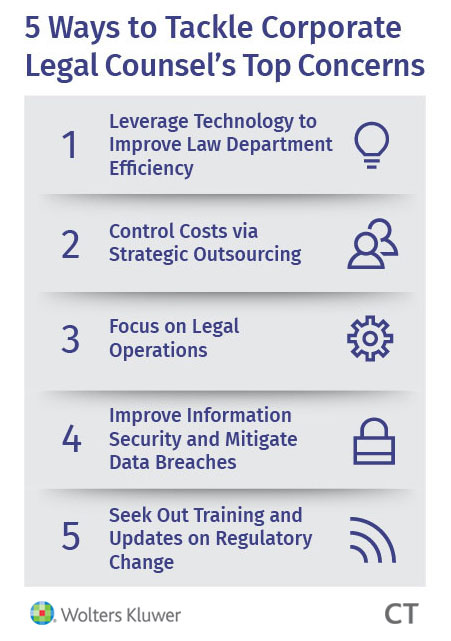
2. Control Costs via Strategic Outsourcing
In addition to leveraging technology, another way in which departments can control costs is through strategic outsourcing. The Altman Weil survey cites price reductions from outside counsel and improved internal efficiencies as the two most frequently used tactics for cost control.
Interestingly, 73.5% of those surveyed noted that outsourcing to alternative legal service providers (ALSPs) to be the method delivering the most value for their dollar. While use of ALSPs received the highest effectiveness score, this tactic was only being used by 19% of respondents.
For legal departments, the ability to shave costs and to handle high-volume transactional processes like corporate filings, contract management, or compliance-related processes, are strong reasons for turning to ALSPs.
3. Focus on Legal Operations
The role of the general counsel has evolved significantly over the past few years. As the scope of their responsibilities continues to grow, so does the need for assistance in keeping the department running smoothly. Hence, the rise of the legal operations manager. According to ACC's Chief Legal Officers 2018 Survey, 47% of CLOs have at least one legal operations professional on staff, up slightly from 43% last year.
Connie Brenton, President and CEO of the Corporate Legal Operations Consortium (CLOC), stresses that collaboration among law firms, third-party providers, and in-house attorneys is necessary to create standards, drive efficiencies, solidify best practices, and keep a focus on the more complex areas where legal counsel can add value to their companies.
4. Improve Information Security and Mitigate Data Breaches
Last year brought with it several high-profile data breaches that garnered media attention, not only because of the size of these incursions, but also because of the missteps that followed. In addition to the issue of public perception, companies are also facing new, more stringent regulations around data privacy and security.
With in-house counsel shouldering more responsibility when it comes to breaches, and even taking the fall in some cases, it is no surprise that information security will be top of mind for companies and their in-house counsel in 2018. (Information security addresses the protection of data in all its forms—whether electronic or physical—and encompasses cybersecurity.)
Below are some data security facts to consider:
- Legal departments cannot rely on antivirus software and firewalls alone for preventing a data breach. For example, these programs won’t prevent an employee from clicking on a suspicious link in a phishing email, thereby launching a malware or ransomware attack.
- All systems have weaknesses that can be exploited. This includes the use of poor passwords (such as “password”, “123456”, and “admin”) or failing to manage who has access to privileged information.
- Third-party vendors are also a potential gateway for cyber thieves to access sensitive information.
A commitment to fundamental information security protocols, such as those outlined by the Association of Corporate Counsel (ACC), can mitigate the risk of a data breach. For more information on ACC guidelines, read Information Security Strategy: Implementing the ACC Model.
5. Seek Out Training and Updates on Regulatory Change
In the latest GC Up at Night report, 42% of respondents find regulatory uncertainty to be their top regulation and enforcement concern, followed by cross-jurisdictional variability (30%).
Law departments can strive to improve governance, risk and compliance (GRC) capabilities by following best practices outlined in the Open Compliance and Ethics Group (OCEG) GRC Capability Model. The GRC Capability Model is the first open-source standard that integrates the various sub-disciplines of governance, risk, audit, compliance, ethics/culture and IT into a unified approach. It can be used to address a range of situations from small projects to organization-wide rollouts, as well as a variety of subject areas from anti-corruption to business continuity to third-party management.
The model’s four components are as follows:
- LEARN: Understand the company’s core objectives, the culture, and the identity of key stakeholders in order to make informed decisions and recommendations.
- ALIGN: Make sure that your strategy is aligned with department and company objectives and influences subsequent course of action.
- PERFORM: Perform and support beneficial actions, address and prevent actions or systems that are harmful or disruptive, and be quick to evaluate a developing event or situation so that you can take appropriate measures.
- REVIEW: Periodically assess your objectives, strategies and actions to make sure that they are actually working and are still aligned to the goals and objectives of the company.
Agility Promotes Efficiency
In 2018, agility is the name of the game for corporate legal counsel teams as they endeavor to do more with less. Leveraging technology, taking advantage of ALSPs, and implementing other positive measures are just some of the ways in which legal departments can improve performance and demonstrate value while staying on top of regulatory change and compliance obligations.
LEARN MORE
Working with a trusted advisor provides efficiencies that help save your firm time and money. To learn more about how CT can help you better manage your compliance needs, contact a CT representative at 844-201-2511 and learn about a variety of our legal solutions services.