An essential regulatory compliance responsibility in the pharmaceutical industry is to effectively manage and report product complaints of adverse drug effects to the U.S. Food and Drug Administration (FDA). Under Title 21 of the FDA’s Code of Federal Regulations, pharmaceutical companies are required to establish written procedures describing the handling of all written and oral complaints regarding a drug product. This is particularly true for health events not described in the product labeling for which the patient outcome is serious.
From 1969 through the present time, the FDA has collected millions of reports of adverse drug reactions most of which were collected between 2004 and 2013, indicating a sharp uptick in reported complaints through the years. While reporting has increased, it does not necessarily mean that adverse drug reactions are occurring more frequently. The expectation is for more frequent and financially severe litigation against drug companies due to expanded public access to product complaints, which were not routinely digitized and stored in a database.
An example of this expanded access is the greater transparency into drug product complaints through the OpenFDA initiative. This is expected to put drug manufacturers at greater risk of litigation. As a recent legal paper stated, “Easier access to a decade’s worth of adverse event reports will allow the plaintiffs’ bar to mine adverse drug event data for potential claims and may lead to increased litigation filings.”
As this potentially more litigious environment develops, pharmaceutical manufacturers are striving to enhance their product complaint handling procedures. Deficiencies in this process are frequently cited as one of the major operating flaws in the industry. A high-quality complaint handling process not only is essential to maintaining regulatory compliance, it also helps to reduce litigation costs and risks. However, superior complaint management is often difficult to achieve because the process typically involves a range of company operations and functions, such as marketing, finance, production, quality control, and regulatory and legal affairs.
By outsourcing portions of this process to a Registered Agent, pharmaceutical companies can ensure more efficient, accurate and streamlined handling of a legal notice (hereinafter a Service of Process or SOP). A Registered Agent can expeditiously route and manage the SOP, confirming the accuracy of information and proper handling throughout this process, reducing the threat of default judgments.
From Complaint to Litigation
Depending on the court involved, lawsuits are typically commenced through a filing by the plaintiff with the court and issuance of a summons by the court clerk. The summons and a pleading (SOP) are then served on the pharmaceutical company notifying the company that a lawsuit has been commenced against it and what the lawsuit is about. Service of the SOP is part of bringing the company within the jurisdictional powers of the court to render any judgment or relief to the plaintiff against the company. The critical time period within which the company must file a response to the lawsuit or risk default commences once the SOP is served on the company.
For some, the process starts with the SOP being served to the pharmaceutical company, via their local offices, registered agent or law firm. The company receives notification of the SOP, reviews the document and acknowledges its receipt. It subsequently processes and logs the SOP internally and then submits it electronically or via mail to a litigation and case management company (when applicable) who then notifies the FDA.
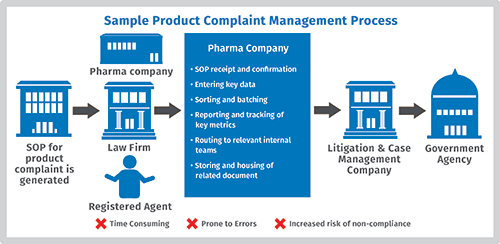
This traditional SOP routing process can consume undue time and, given the various parties involved and the significant scope of internal work performed by the drug company, is prone to errors, increasing litigation costs and risks.
To obviate these concerns, the onus is on pharmaceutical companies to streamline the product complaint management process. In this regard, an integrated solution leveraging a Registered Agent that can oversee the SOP routing ensures utmost accuracy and speed.
Improving the Product Complaint Management Process via Registered Agent
A Pharma company can streamline their product complaint process by directing the SOP handling to their registered agent. If all the product complaints are directed to an experienced Registered Agent, they can expeditiously and accurately route the SOP, via an automated process, to their Litigation and Case Management provider. The graphic below illustrates how the process would flow in this scenario.
At each step of this process, the Registered Agent can confirm the integrity of the information received and presented. This accurate, reliable and timely handling of the SOP results in reduced drug company staff time and cost, while lowering the risk of default judgments. A Registered Agent can also manage other compliance-related documents, such as time-sensitive legal notices and government correspondence.
Choosing the right partner
Not all Registered Agents are the same. Some are Six Sigma certified, with expert teams of in-house compliance specialists and attorneys who understand the unique legal and regulatory risks of the pharmaceutical industry. In performing due diligence in the selection of a Registered Agent, drug manufacturers should evaluate a firm’s technical capabilities, particularly its integration capabilities with the pharmaceutical company’s existing management system and workflows. This capability assures that complaints are automatically sent to litigation and case management companies and government agencies. Companies also should seek out Registered Agents employing centralized SOP management processes, with fast and accurate reporting features, easy-to-achieve SOP history retrieval, and scalability.
Conclusion
With the potential likelihood of litigation against pharmaceutical companies expected to rise due to changes in the existing process, drug manufacturers need to ensure the utmost efficiency and accuracy in their handling of their Service of Process. By outsourcing much of this work to a qualified Registered Agent, companies can reduce their product complaint management process’ costs and risks, while ensuring they comply with regulatory guidelines.
Learn More
Learn more about the ways in which CT can help implement a process to manage service of process. Contact your representative or call 855-316-8948 (toll-free U.S.).
Join the conversation. Follow us on Twitter, LinkedIn, Google+ and Facebook.